
Loving Students Stupid
Why our best intentions sometimes undermine learning

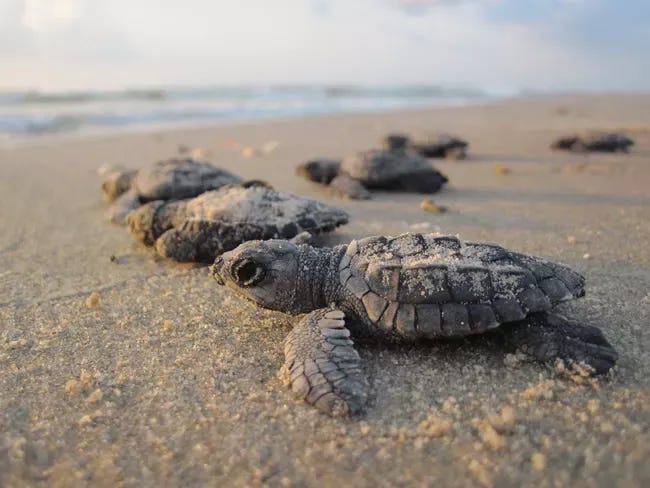
A couple of weeks ago, a video showing a young girl dumping a bucket of baby sea turtles into the surf went viral. The original poster said she was giving the hatchlings “a head start.” Yet as numerous posters pointed out, her gesture was misguided and harmful. By “helping” the young turtles with a difficult crawl from their nest to the ocean, she was weakening their ability to survive adulthood. Without the crawl, their flippers don’t strengthen properly. Without that crawl, they wouldn’t be able to orient themselves in the world. It helps them align to the horizon, the moon, and the waves. And the most damning–that crawl stamps them with a mysterious magnetic GPS that allows them to find their way back to their home beach as adults.
This gesture looks compassionate. She seems like a good person. But she’s actually harming the turtles—not just for the 45 minutes it would have taken them to tumble down the dunes and flail into the ocean, but for the rest of their lives.
This kind of well-intentioned harm isn’t limited to sea turtles. The same thing happens in education. About fifteen years ago, I had an assistant principal who was a tough old salt. She would come into my room complaining about the do-gooder teacher down the hall who was “loving these kids stupid.”
Her meaning was simple: kind, well-meaning teachers, in an effort to save time and struggle, often cut students out of the very kind of messy thinking that strengthens the higher-order cognition they need to be successful.
Every teacher I know has done this. I certainly have. Instead of removing barriers, we remove the struggle. I do not doubt that teachers do this out of care for the students, but in doing so, they deny students the struggle they’ll need to survive intellectually later in life.
Early in John Warner’s book Why They Can’t Write, he explains that training wheels prevent children from developing the very skill they’ll eventually need to ride a bike: balance. Warner writes: “When it comes to teaching writing, we’ve been doing something similar, giving students training wheels that actively work against their ability to learn how to write.” He cites the proliferation of the five-paragraph essay formula, which short-circuits the development of a key skill kids will need if they’re ever going to write anything: making choices for rhetorical effect.
Both my assistant principal and John Warner are pointing to the same truth: in our effort to help students, we sometimes remove the struggle that produces learning. Do I read the text out loud because kids just can’t keep up? I’m helping them along! Do I summarize all the difficult texts? I’ve got to get through this unit!
So how do we help students engage with the struggle instead of throwing them over our backs and shouldering them to the finish line? Here are some questions I’ve started to ask myself before jumping in to help a student.
Am I removing a barrier, or am I removing the struggle?
Are my scaffolds doing the students’ thinking for them?
Are my sentence stems actually helping students generate their own thoughts?
Are the questions I’m asking leading students to their own inquiry? Or better yet, why aren’t students making up their own questions?
Do my graphic organizers do the organizing for students?
Am I trying to get through the lesson, or am I making sure students are actually thinking and wrestling with the learning?
Is this support creating greater independence for them or greater dependence on me?
Confusion and struggle are often the byproducts of real learning, real wrestling with new content. In our efforts to “meet our students where they are” and “build a relationship,” we often offer them shortcuts that make their brains less likely to develop on the way to the sea. Remember the turtles: the crawl isn’t a design flaw; it’s the very reason the strong will survive.
Hi Liz,
Excellent advice and if I were still teaching, I would keep those questions on my plan book, on my desk, and probably on a sticky note on every book I’ll read or teach from. Productive struggle is what develops resilient learners. I hope everyone takes your advice.
Wonderful analogy and checklist of questions! Thank you.
The biggest hurdle is: if we don’t read it together in class—will they read?! 🙃