

In the fall of 1987, I took a writing class at the University of Kentucky called “Composition for Teachers.” I had no idea who the teacher, Wendell Berry, was. The class met on Tuesday afternoons in Miller Hall, built in 1898, one of the oldest buildings on campus.
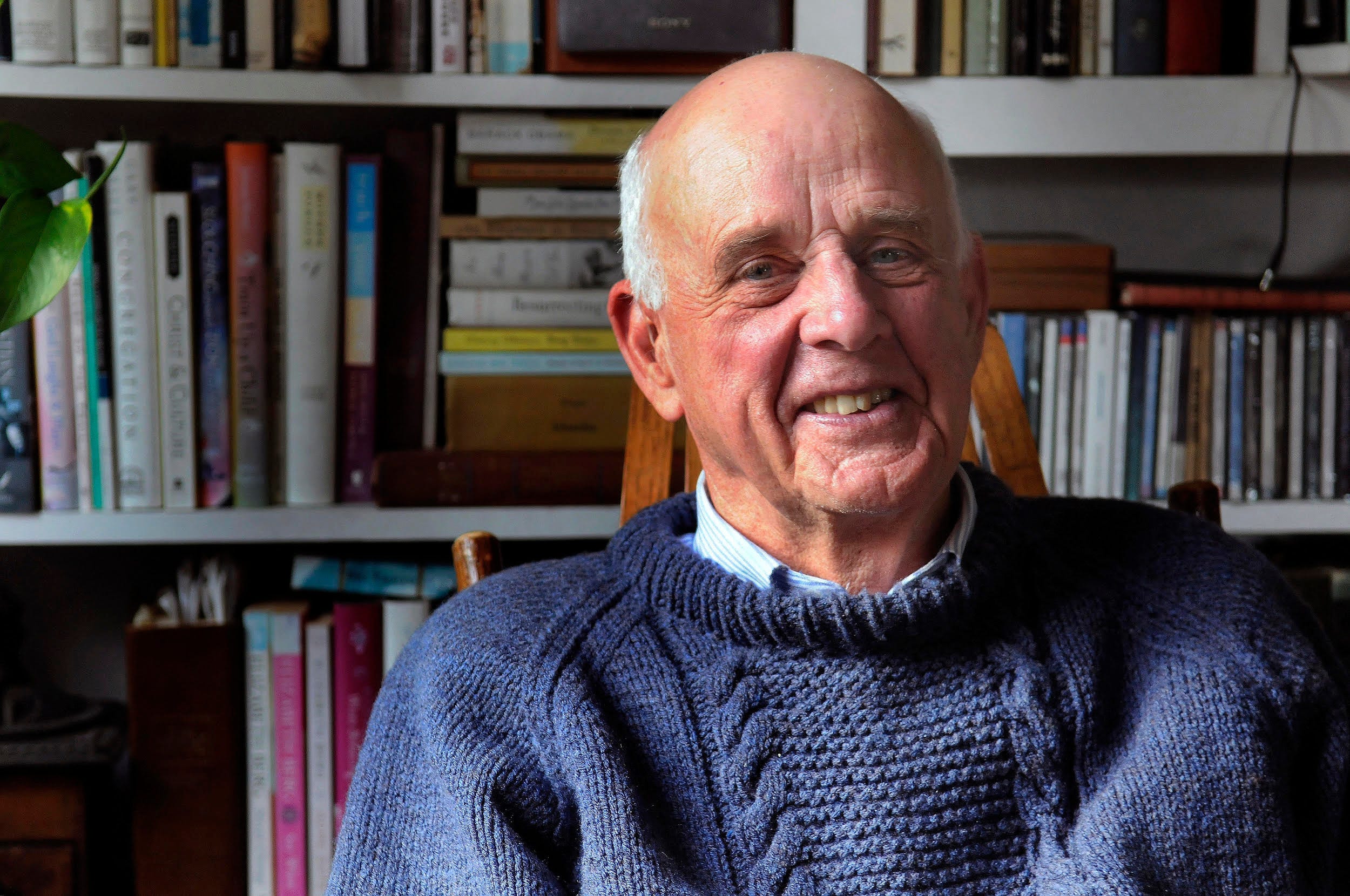
On that first day, Berry walked in looking like every farmer I’d ever seen standing around a tobacco warehouse telling lies. He wore khakis, brown lace-up shoes with rubber soles, and a blue button-down shirt. His hair was gray on the sides, and his face was tan except for a circle of white on his forehead, the mark of a man who works under the sun and wears a brimmed hat. He didn’t look like an academic. He looked like my father – an austere and simple farmer, the grooves in his cheeks when he smiled like plowed rows.
In an interview published around this time in Our Other Voices, Berry was asked why he was returning to the University of Kentucky after quitting teaching a decade earlier in 1977. He replied that those who were concerned about education should do something about its demise.
Our first assignment was to write an essay on a topic of our choice. I can’t remember what topic I chose, but I’m sure I tossed it off with the same blind aplomb I wrote most required academic drivel. I was in my last semester of college, and I had never received anything less than an A in an English class.
When he returned the essays to the class, there was a large red F on the top of my paper. The University of Kentucky didn’t even allow F’s. They used E’s, but there it was, almost an inch tall, the first I’d ever received on a piece of writing in my life.
During those first few weeks, the class had been thick with schism. An off-balance theological argument occurred between Berry and some woman who thought Flannery O’Connor was a Baptist. Soon a pedagogical flap occurred when an earnest disciple of the latest College of Education writing method could not believe that Berry didn’t endorse the idea of prewriting through journaling, mapping, or bubbling. Berry didn’t suffer fools or process over product gladly.
I don’t want to leave the impression that the class was a crucible or that Berry was dour, judgmental, or embittered. Just the opposite. Even at his most didactic, his comments in class were less like sermons and more like a call to arms. His intensity came from love and belief in what he was doing, rather than severity.
Plus, Berry had a great sense of humor. His blue eyes crackled with mischief when he told us a good story, which was often, and sometimes he entertained us with sample cheers from his Port Royal athletic days (“Go back, go back, go back into the woods/Your team’s all farmers and your coach is no good”).
“He’s like Jesus with a plow,” my friend Dina said one day at lunch after we had gotten another set of essays back. This time we both received D’s. “And we’ve gotta walk beside him with our hands on that plow if we’re going to learn anything from him.”
Before midterms, most of the class dropped out until only twelve of us remained. The apostle metaphor was not lost on us.
Because we were going to be English teachers, he expected a great deal from us—and was frustrated by our inability to think for ourselves. Every day, he told us to think, to rise above ignorance. He warned that bad writing would bring “boredom, tears, and shame” in later life. A teacher’s job, he told us, was to arm children with tools against loneliness.
He read aloud to us—Shakespeare’s King Lear, the Book of Ecclesiastes, Dante’s Divine Comedy—his sonorous voice rolling through that old room like the voice of God, past the high glass windows, the banging radiator, the worn wooden floors. He disdained the idea that these great works should be studied “as literature,” which he felt caused an unnecessary and sterile disconnect between the work and its instructive value.
“At some point, each of you will have to stand in front of someone,” he told us one dark November afternoon, “and tell them that you love them.” He considered those great works as instructions on how to do just that.
Berry believed literature mattered because life mattered. We didn’t read King Lear merely to know something about King Lear. We read it because we were trying to figure out how human beings should live with one another.
At some point, I wrote a pithy little essay about body image, and Mr. Berry returned the paper with a C+ on it and a note that read: “This is just good enough that I wish it were better.” It was the kind of comment that a young writer remembers forever. He was saying, “I can see what this could be. I can see what you’re trying to do.”
At that point in the semester, I cared less about getting a good grade and more about simply being a better human being. He wasn’t really teaching us composition as much as he was teaching us how to pay attention, think independently, live honestly, and take responsibility for our words and our lives.
I don’t remember learning a specific skill from him (other than “Omit needless words!” a lesson I still haven’t mastered), but he made more of an impression on me, as a teacher and a writer, than any other teacher I’d ever had. He witnessed to us the importance of honesty and practicing one’s own sermons.
I got a B in that class and probably didn’t deserve it. I came away from it knowing that I had been in the presence of a deliberate mind at work. And I came away knowing that I would never look at writing or the teaching of writing the same way.
Another Kentucky writer, Jesse Stuart, wrote that “….a teacher lives on and on through his students. Good teaching is forever, and the teacher is immortal.”
In 30 years of teaching, I’ve never forgotten those lessons I learned in 1987 from a man who looked like a farmer and spoke with the voice of God. I didn’t understand his approach to teaching, writing, or thinking then, but I’ve spent the rest of my life trying to walk it out.
Today the world says goodbye to a great poet, a great Kentuckian, a champion of rural agriculture and community, a man of letters. Today I say goodbye to my old teacher, Wendell Berry—forever in my heart, and forever in my classroom.
He obviously taught you more than you let on. Thanks for this brilliant eulogy.
Looks like you, indeed, learned a lot from Mr. Berry, Liz. Perfect 7 am read, makes me want to go write. ❤️
I’ve always admired Wendell Berry for standing up. Kentucky Living ran a story about him some years ago. He was a deep, complex man whose work will be forever referenced. Having grown up on a large, working farm with Burley, dairy, strawberry U-pick, two fishing pay lakes—even a general store in Finchville—I agreed with much that he wrote. I have not read a lot of his poetry, but should.
The Berry Center is not far from us in Oldham County. I used to chat with daughter, Mary, at the New Castle family farm, Smith-Berry Winery, that is no more—her ex sold it 3 years ago. We went there all the time for their dinners and thought the wine was among the best local and regional.
My best, Anita
PS When I get over two rotator cuff surgeries, torn meniscus and torn ankle, and resulting nerve damage, I pray to be back among the living—and writing. Recently joined the local Women Who Write, a gold mine of the most diverse, captivating writers I’ve ever met. You might find resources from the group. I attended the annual writer’s retreat right by my house late June, surprised myself, produced the opening chapter of my memoirs in record time. I understand a fall conference is coming up, usually 1 1/2 hours from Louisville. Message me if interested.